| HOME |
| INDEX ARTICLES |
| CONTACT US |
|
ART
Venice: Canaletto and His Rivals

Venice: Canaletto and His Rivals is organized by the National Gallery of Art, Washington, the sole U.S. venue for the show, and the National Gallery, London, where it is on view through January 16, 2011.
The Exhibition
Europe has many beautiful cities, but only Venice inspired a school of view painters who depicted the city, stone by stone and canal by canal, capturing views that are still recognizable today. The genre of vedute (view paintings) culminated in Venice in the 18th century with Giovanni Antonio Canal (1697–1768), known as Canaletto.
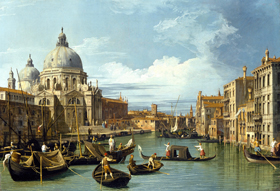 In 1719 Canaletto, who was trained as a painter of theatrical scenery, visited Rome where he was inspired to begin view painting. In the late 1720s, in response to market demand, he began to replace the somberness of his earlier works with views drenched in sunlight. Within a decade, Canaletto dominated the genre and the exhibition will include many of his greatest masterpieces, from such prestigious collections as that of Her Majesty Queen Elizabeth II and the State Hermitage Museum, St. Petersburg.
Throughout the exhibition Canaletto's major works will be juxtaposed with those of his rivals to illuminate their complex relationships. Organized chronologically, the exhibition includes a pivotal work by Gaspar Vanvitelli (1653–1736), Canaletto's precursor and the founding father of Italian view painting, titled The Molo from the Bacino di San Marco (1697). Trained in the Netherlands and based mostly in Rome, Vanvitelli depicted a Venice distinctly calm in comparison to the work of Canaletto and his contemporaries who followed.
One of Vanvitelli's successors and the first view painter in Venice to depend on foreign patronage was Luca Carlevarijs (1663–1729), an artist Canaletto soon eclipsed. Visitors to the Gallery will see important early works by Canaletto, such as The Piazza San Marco, Looking East (1723), on view next to similar subjects by Carlevarijs.
The festivals, regattas, and ceremonies of Venice will be showcased in the exhibition through several important works, including Canaletto's The Molo from the Bacino di San Marco on Ascension Day (c. 1733–1734). Historical events of the city were also recorded by the view painters, such as in Carlevarijs' pioneering composition The Reception of the British Ambassador Charles Montagu, 4th Earl of Manchester, at the Doge's Palace, 22 September 1707 (c. 1707–1708), which will be paired with Canaletto's masterpiece The Reception of the French Ambassador Jacques-Vincent Languet, Comte de Gergy, at the Doge's Palace, 4 November 1726 (c. 1727).
Canaletto's closest competitor was the short-lived but highly original Michele Marieschi (1710–1743), the most spontaneous of the view painters. Marieschi employed characteristically broad brushstrokes and a fondness for unexpected viewpoints that come to light in The Rialto Bridge from the Riva del Vin (c. 1740s).
At the height of Canaletto's fame, his workshop offered the finest training a view painter could receive. He taught his nephew Bernardo Bellotto (1721–1780), whose views are sometimes confused with those of his uncle. A unique characteristic of Bellotto's style is his vibrant blue sky, seen most dramatically in The Piazzetta, Looking North (c. 1743).
The development of Venetian view painting culminated with Francesco Guardi (1712–1793), whose works close the exhibition. A rival who appeared during the final decade of Canaletto's life, Guardi anticipated the rise of romanticism in the 19th century, and emphasized the fragility of Venice rather than its permanence. In San Giorgio Maggiore and the Giudecca (about 1780), Guardi depicts a gentle, poetic impression of the city.
View painters prized topographical accuracy in their work. A tool they may have used to construct their views is the camera obscura—an optical device that helped painters project, invert, and trace the buildings and vistas of Venice. Two 18th-century examples of the camera obscura will be on view, providing an opportunity for visitors to learn more about this scientific tool.
The map entitled Iconografica Rappresentatione della Inclita Città di Venezia (1729), a recent acquisition of the National Gallery of Art, combines the talents of the leading Venetian figure painter of the decade, Sebastiano Ricci (1659–1734), and the leading Venetian printmaker in the 1720s and early 1730s, Giovanni Antonio Faldoni (c. 1690–c. 1770), with views by Francesco Zucchi (1692–1764), mostly after Luca Carlevarijs. Using groundbreaking surveying tools and mathematics of the day, Lodovico Ughi (active 1710–1730) prepared precise measurements of buildings, streets, canals, and gardens, making this map—measuring approximately 60 x 72 inches—authoritative for more than a century.
Curators and Catalogue
The exhibition is curated by Charles Beddington, a leading specialist on Canaletto. It is coordinated at the National Gallery of Art, Washington, by David Alan Brown, curator of Italian and Spanish paintings.
Published by the National Gallery Company, London, and distributed by Yale University Press, the exhibition catalogue includes essays by Beddington and Amanda Bradley, assistant curator of pictures and sculpture, The National Trust. Biographies for each artist are followed by short introductions to the works, which are grouped chronologically by artist. The 192-page catalogue includes 130 color illustrations and is available for purchase in the Gallery Shops in hardcover and softcover. To order, please visit our Web site at shop.nga.gov; call (800) 697-9350 or (202) 842-6002; fax (202) 789-3047; or e-mail mailorder@nga.gov.
The exhibition in Washington is made possible by the Bracco Foundation, which promotes cultural, scientific, and artistic expressions to improve the quality of life.
It is also made possible through the generous support of the Anna-Maria and Stephen Kellen Foundation.
It is supported by an indemnity from the Federal Council on the Arts and the Humanities.
SOURCE:National Gallery of Art
|CiaoAmerica.net|